
Is Your Wallet Giving You Back Pain? The Science Behind Pocket Placement
You've tried a new office chair. You've done the stretches. Maybe you even bought a standing desk. But that nagging lower back pain won't quit. Here's a question your chiropractor might ask that surprises most people: where do you keep your wallet?
If you're one of the millions of men who sit on a thick bifold wallet every day, your wallet could be causing your back pain — and there's actual science behind it. It even has a name: piriformis syndrome, sometimes called "wallet sciatica" or "fat wallet syndrome."
[IMAGE: Side-by-side illustration showing pelvic tilt caused by sitting on a wallet vs. balanced sitting without one]What Is Wallet Sciatica?
When you sit on a wallet in your back pocket, it creates an uneven surface under your pelvis. One hip sits higher than the other. Over time — and we're talking hours per day, five days a week, for months or years — this asymmetry causes real problems:
- Pelvic tilt: Your pelvis rotates slightly, which throws your spine out of alignment.
- Piriformis compression: The wallet presses directly on the piriformis muscle, which runs over the sciatic nerve. Compress that muscle, and it irritates the nerve beneath it.
- Sciatic nerve pain: This manifests as pain, tingling, or numbness in your lower back, hip, buttock, and sometimes down the leg.
A study published in the New England Journal of Medicine documented cases where simply removing a wallet from the back pocket resolved chronic sciatic symptoms. Dr. Gerard Varlotta, a sports medicine physician at NYU Langone, has called back-pocket wallets "one of the most common and overlooked causes of lower back pain in men."
How Thick Is Too Thick?
Research suggests that any object thicker than about 0.5 inches (13mm) creates enough pelvic asymmetry to cause problems over time. The average men's bifold wallet? About 0.75 to 1.5 inches thick when loaded with cards, cash, and receipts.
For context, here's how common wallet types compare:
- Stuffed bifold: 1.0 - 1.5 inches — well into the danger zone
- Slim bifold: 0.5 - 0.8 inches — borderline
- Minimalist cardholder: 0.3 - 0.5 inches — generally safe
- Front pocket wallet: Doesn't matter how thick — you're not sitting on it
The takeaway: thickness matters, but placement matters more. Even a slim wallet in your back pocket is worse than a slightly thicker one in your front pocket.
[IMAGE: Cross-section diagram comparing wallet thicknesses — bifold at 1.2 inches vs. minimalist cardholder at 0.4 inches]The Two Fixes That Actually Work
Fix 1: Switch to Your Front Pocket
The simplest fix is moving your wallet to your front pocket. This eliminates the pelvic tilt entirely. The catch? Most bifolds don't fit comfortably in a front pocket. That's where slim wallets and cardholders come in.
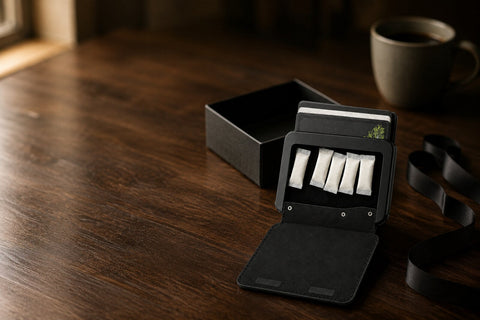
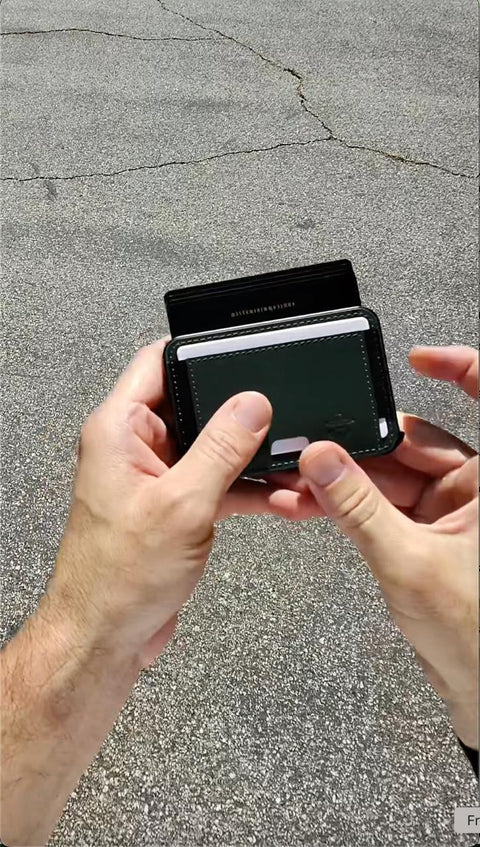
Wallets designed for front-pocket carry — like the BNDT Maverick at just 0.35 inches thick — sit flat without creating a visible bulge. You get your cards, RFID protection, and zero back problems.
Fix 2: Slim Down Your Wallet
If you're not ready to switch pockets, at least reduce the bulk:
- Remove anything you don't use weekly. That gym membership card from 2023? Your Costco card you have in Apple Wallet anyway? Gone.
- Stop carrying cash receipts. Take a photo and toss them.
- Limit yourself to 5 cards. ID, debit, credit, insurance, one other. That's it.
- Switch to a cardholder. Even moving from a bifold to a slim cardholder can cut your wallet thickness by 60-70%.
What Chiropractors and Physical Therapists Say
This isn't fringe science. The American Chiropractic Association lists prolonged sitting on a wallet as a contributing factor to lower back pain. Physical therapists routinely ask patients about wallet placement as part of their intake assessment.
Dr. Arlan Fuhr, founder of Activator Methods (one of the most widely used chiropractic techniques), has written extensively about the connection between posterior pocket objects and spinal misalignment. His recommendation is simple: never sit on your wallet.
The fix doesn't require expensive treatment. It requires changing a habit.
[IMAGE: Photo of a man comfortably sitting at a desk with a slim wallet visible in his front pocket]Real Talk: Is Your Wallet Actually the Problem?
To be fair, not every case of back pain is caused by your wallet. But if you:
- Sit for 4+ hours a day (desk job, driving, etc.)
- Carry your wallet in your back pocket
- Have a wallet thicker than half an inch
- Experience pain primarily on one side of your lower back or hip
...it's worth trying the switch for two weeks. Move your wallet to your front pocket — or better yet, swap to a slim cardholder like the BNDT Ranger (0.3 inches thick, 0.5 oz) or the Maverick (0.35 inches). If the pain improves, you've found your culprit — and the fix cost you less than a single chiropractic visit.
The Bottom Line
Your wallet shouldn't be a health hazard. Sitting on a thick wallet creates pelvic asymmetry that compresses the piriformis muscle and irritates the sciatic nerve. The fix is straightforward: carry less, carry slimmer, and carry in your front pocket. Your back will thank you within days.

in
just purchased