

Choosing a minimalist wallet comes down to four decisions: how many cards you carry daily, whether you need cash storage, what material suits your lifestyle, and whether you want front-pocket or MagSafe carry. Once you answer those questions, the right wallet becomes obvious. This guide walks you through each decision with real-world recommendations so you stop overthinking it and start carrying less.
If you have been carrying a traditional bifold for years, the switch to a minimalist wallet can feel intimidating. Reddit threads are full of people asking the same question: How do I downsize from a bifold? The answer is simpler than you think. Most people carry 8-12 cards in their bifold but only use 3-5 daily. A minimalist wallet forces you to audit what actually matters, and the result is a slimmer profile, less back pain, and faster checkout.
How Many Cards Do You Actually Need?
Before you buy any minimalist wallet, empty your current wallet onto a table. Separate everything into three piles: daily essentials, weekly needs, and just in case cards. Most people discover their daily essentials pile has 4-6 cards: a primary debit card, a credit card, a drivers license, maybe an insurance card, and a transit or gym pass.
The just in case cards — that Costco membership you use twice a month, the loyalty card for a coffee shop three miles away — can live in your car, your phone case, or a digital wallet app. Apple Wallet and Google Wallet now support most loyalty programs and even some insurance cards.
Here is a practical breakdown by card count:
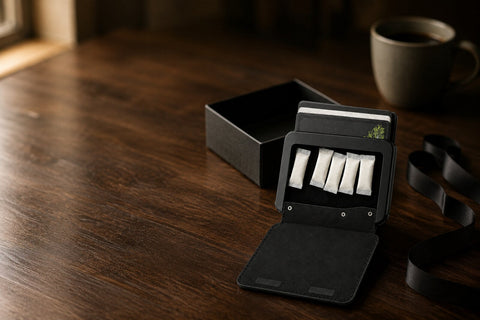
- 1-5 cards: You are a true minimalist. A slim cardholder like the BNDT Maverick is your ideal match. It holds up to 7 cards in a sleek profile that disappears in your front pocket.
- 5-8 cards: You need a bit more capacity without the bulk. The BNDT Outlaw handles up to 12 cards with its expandable aluminum frame while staying remarkably thin.
- 8-12 cards: You are not ready to fully downsize, and that is fine. Look for a wallet with a quick-access mechanism so you are not fumbling through a stack. The BNDT Ranger gives you capacity and organization with a built-in cash strap.
The key insight: your card count determines your wallet category. Do not buy a 12-card wallet if you only carry 4 cards. You will fill it with junk again within a month.
Front Pocket vs Back Pocket
This is the decision most people skip, and it matters more than you think. Back-pocket carry with a traditional bifold is one of the leading causes of sciatic nerve irritation. Sitting on an uneven surface for hours every day compresses the piriformis muscle and can cause lower back pain, hip pain, and even numbness down your leg. Chiropractors call it wallet sciatica and it is more common than you would expect.

Front-pocket carry eliminates this entirely. A slim minimalist wallet fits comfortably in your front pocket without creating a visible bulge. It is also significantly harder to pickpocket from a front pocket, which matters if you travel internationally.
Front pocket advantages:
- Eliminates back pain from uneven sitting
- More secure against pickpockets
- Faster access when standing
- No sitting on your wallet at restaurants
Back pocket advantages:
- Familiar for bifold users transitioning
- Slightly more pocket space up front for phone
- Some people prefer the muscle memory
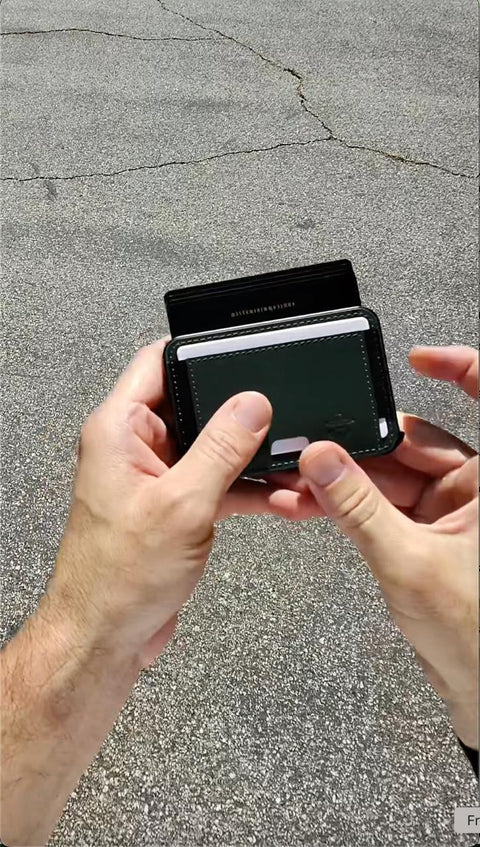
If you carry your phone in your right front pocket, your minimalist wallet fits perfectly in the left front pocket. If you use an iPhone with MagSafe, you can skip the pocket debate entirely and mount your wallet directly to the back of your phone. The BNDT Maverick and Maverick 2.0 both feature MagSafe compatibility, turning your wallet into a seamless extension of your phone.
Aluminum vs Leather vs Carbon Fiber
Material choice affects durability, weight, feel, and price. Here is an honest comparison of the three most common minimalist wallet materials:
Aluminum
Aluminum wallets are lightweight, rigid, and provide natural RFID blocking without any additional shielding. The rigid frame protects your cards from bending and snapping, which is a real concern if you sit on a leather wallet in your back pocket. The downside is that aluminum can scratch cards if the interior is not lined properly. Cheaper aluminum wallets are notorious for this — look for wallets with interior padding or card separators.
The BNDT Outlaw uses a precision-machined aluminum frame with a quick-trigger card deployment system. Cards fan out at the push of a button, so you are not sliding them against raw aluminum edges. This solves the scratching problem that plagues most metal wallets.
Full-Grain Leather
Full-grain leather is the highest quality leather you can buy. Unlike top-grain or bonded leather, full-grain retains the complete grain surface, which means it develops a natural patina over time and actually looks better with age. It is also the most durable — full-grain leather wallets can last 10+ years with minimal care.
The tradeoff is that leather does not provide RFID blocking on its own. You need an embedded RFID shield, which quality wallets include. Leather is also slightly thicker than aluminum, though modern construction techniques have made this difference negligible.
BNDT uses full-grain leather across its wallet line, including the Maverick series. The leather is sourced for durability and develops character over months of daily use.
Carbon Fiber
Carbon fiber wallets are the lightest and most scratch-resistant option. They look futuristic and are virtually indestructible. The downside is cost — genuine carbon fiber wallets typically run $100+ — and they can feel cold or clinical compared to the warmth of leather. Carbon fiber also does not develop a patina, so it looks the same on day one as it does on day 1,000. Some people love that consistency; others find it sterile.
For most people, the sweet spot is a wallet that combines materials. An aluminum frame for rigidity and RFID blocking, wrapped in full-grain leather for feel and aesthetics, gives you the best of both worlds without the carbon fiber price tag.
Do You Need Cash Storage?
This is increasingly a personal question. In 2026, most transactions are contactless or card-based. But cash is not dead, especially for tipping, splitting bills at restaurants that do not do Venmo, farmers markets, and international travel where card acceptance varies.

Minimalist wallets handle cash in three ways:
- No cash storage: Pure cardholders like the Maverick. You carry zero cash. If you need cash, you fold a few bills and tuck them behind the wallet or in another pocket.
- Cash strap or band: An integrated elastic strap on the exterior holds folded bills flat against the wallet. The BNDT Ranger uses this approach. It keeps cash accessible without adding bulk to the card compartment.
- Cash clip: A spring-loaded metal clip on one side. These hold bills securely but add thickness and can scratch your phone if carried in the same pocket.
If you use cash fewer than twice a week, skip dedicated cash storage. Fold two emergency twenties and tuck them behind your cardholder or in your phone case. If you use cash daily, get a wallet with an integrated cash strap — it is the slimmest solution that still gives you quick access.
MagSafe: The Game Changer
MagSafe compatibility has fundamentally changed how people carry wallets. Instead of occupying a pocket, your wallet magnetically attaches to the back of your iPhone. It is one less thing to grab when you leave the house, and it makes tap-to-pay seamless — detach wallet, tap card, reattach.
Not all MagSafe wallets are created equal. The critical factors are:
- Magnet strength: Cheap MagSafe wallets use weak magnets that detach in your pocket or when you pull your phone out. Quality MagSafe wallets use N52-grade neodymium magnets arranged in the Apple MagSafe ring pattern for maximum hold.
- Card capacity: MagSafe wallets need to stay thin enough that they do not make your phone unwieldy. 3-5 cards is the sweet spot.
- Standalone use: The best MagSafe wallets also work as standalone cardholders when detached. You should be able to leave your phone at the table and take just the wallet to the bar.
The BNDT Maverick and Maverick 2.0 are built around MagSafe. Strong magnetic attachment, slim profile, and they work perfectly as standalone wallets. The Maverick 2.0 adds an enhanced magnetic array for even stronger hold on iPhone 13 and later models.
MagSafe wallets are compatible with iPhone 12 and later. If you have an iPhone 11 or earlier, you will need a MagSafe-compatible case with built-in magnets to use any MagSafe wallet. More on compatibility in our MagSafe compatibility guide.
Recommended BNDT Wallets by Use Case
Here is our honest recommendation based on how you actually carry:

The Everyday Minimalist: BNDT Maverick
Best for: 1-5 cards, no cash, front pocket or MagSafe carry.
The Maverick is our flagship cardholder. Full-grain leather, MagSafe compatible, RFID blocking, and a slim profile that holds up to 7 cards without bulk. At $59.77, it undercuts comparable wallets from competitors that charge $95+ for similar features minus MagSafe. This is the wallet for people who have fully committed to the minimalist lifestyle.
The Card-Heavy Carrier: BNDT Outlaw
Best for: 5-12 cards, occasional cash, front pocket carry.
The Outlaw uses a precision aluminum frame with a quick-trigger mechanism that fans your cards for instant access. It handles up to 12 cards while staying slim enough for front-pocket carry. Built-in RFID blocking from the aluminum body. If you are transitioning from a bifold and not ready to drop below 5 cards, start here.
The Cash Carrier: BNDT Ranger
Best for: 4-8 cards plus cash, front or back pocket carry.
The Ranger combines a card compartment with an integrated cash strap. It is the most versatile option for people who still use cash regularly but want a slimmer profile than a bifold. RFID blocking included.
The iPhone User: BNDT Maverick 2.0
Best for: 1-5 cards, MagSafe carry on iPhone 12+.
The Maverick 2.0 takes everything great about the original Maverick and enhances the magnetic array for stronger MagSafe hold. If your primary carry method is attached to your iPhone, this is the one. Full-grain leather, RFID blocking, and that satisfying magnetic snap when you attach it.
Quick Decision Framework
| Need | Best Pick | Why |
|---|---|---|
| Fewest cards possible | Maverick | 7-card capacity, slimmest profile |
| Transitioning from bifold | Outlaw | 12-card capacity, quick-trigger access |
| Cash + cards | Ranger | Integrated cash strap |
| iPhone MagSafe carry | Maverick 2.0 | Enhanced magnetic array |
| Best overall value | Maverick | $59.77 with MagSafe + lifetime warranty |
Last updated: March 2026

in
just purchased